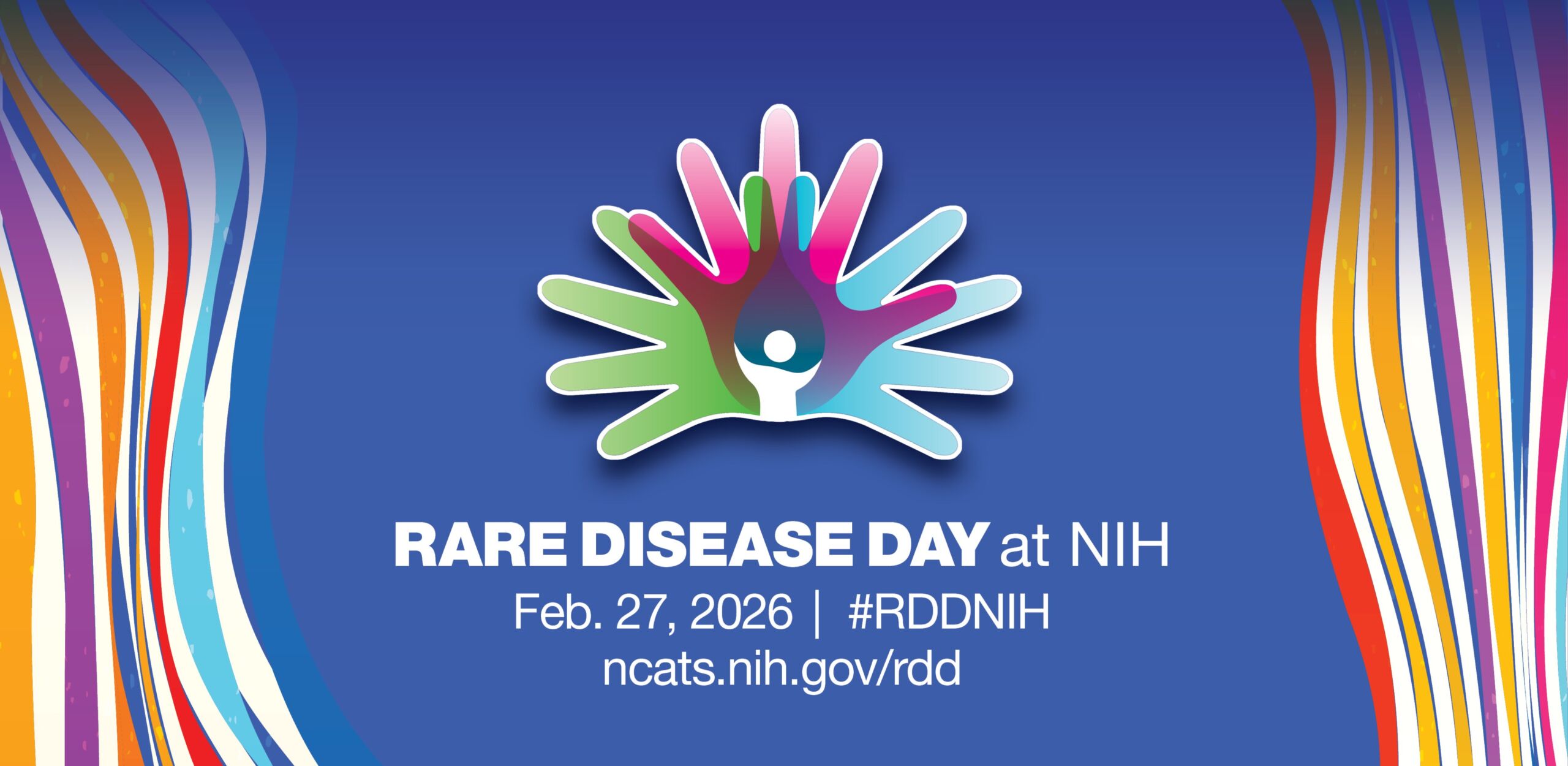
Don’t miss the in-person and virtual celebration of Rare Disease Day at NIH on Friday, February 27, 2026, from 9 am to 5 pm EST. Each year, the NIH’s National Center for Advancing Translational Sciences (NCATS) sponsors the event as part of the global Rare Disease Day observance. Goals include raising awareness about rare diseases, the people they affect, and NIH collaborations that address scientific challenges and advance research for new treatments.
The event will be held in person at NIH Main Campus (Natcher Conference Center). There also will be a virtual livestream via NIH VideoCast with the event archived for replay afterward. The agenda will feature panel discussions, rare diseases stories, in-person exhibitors and scientific posters, and an art exhibition.
The RDCRN will host a booth during the event. You can visit our booth at any time to learn more about the RDCRN.
In addition, you can find RDCRN participants at the following posters and exhibits:
Posters
- Advancing Rare Diseases: Vascular Anomalies Research with CaNVAS
- Presenter: Michael Jeng, MD
- Describing our U54 consortium on vascular anomalies, the three diseases, projects, and cores.
- Advancing Research, Transforming Lives: A 20-Year Patient and Researcher Partnership
- Presenter: Jill Williams
- For more than 20 years, the National Urea Cycle Disorders Foundation and the Urea Cycle Disorders Consortium have partnered to accelerate research and improve outcomes for people affected by urea cycle disorders (UCDs). The partnership has been continuously funded by the NIH’s Rare Diseases Clinical Research Network since 2003 and has also received significant philanthropic support from the O’Malley Family Foundation and the Kettering Family Foundation.
- UCDs are a group of rare metabolic disorders that can lead to high ammonia levels causing neurological injury, coma, and death. Three decades ago, a UCD diagnosis meant near-certain fatal outcomes in infancy. If patients survived, they faced likely brain damage and high levels of morbidity into childhood. Today, UCDs have been transformed into complex but manageable chronic illnesses for many.
- Advances driven by this partnership have contributed to increased life expectancy, improved quality of life, and better support for patients and caregivers across the disease spectrum. Patient priorities have informed research questions, clinical trial design, and outcome measures, helping to translate discovery into meaningful clinical impact. Together, the Foundation and Consortium have supported the development of multiple new treatments, generated hundreds of peer-reviewed publications, and built a robust, international research network.
- This poster highlights key milestones and outcomes of the partnership, including therapeutic development, knowledge generation, and patient-centered impact. It illustrates how long-term, trust-based collaboration between patient advocacy organizations and researchers can accelerate progress in rare disease research.
Exhibits
- ARISEN (Autoimmunity, Rasmussen’s, Inflammation, & Status Epilepticus research Network)
- Presenter: Kaci McCoy
- ARISEN is a research consortium that is part of the Rare Diseases Clinical Research Network (RDCRN). ARISEN aims to longitudinally study the clinical course and neurocognitive outcomes, patient/caregiver-reported outcomes, and biomarker discovery in rare neuroinflammatory diseases by leveraging a novel multi-center patient registry. ARISEN includes patients with autoimmune encephalitis (AE), Rasmussen syndrome (RS), and new onset refractory status epilepticus (NORSE).
- Osteogenesis Imperfecta Foundation
- Presenter: Kenna Coleman
- The Osteogenesis Imperfecta Foundation, Inc. (OI Foundation) is the only voluntary national health organization dedicated to supporting people with osteogenesis imperfecta and their families. The Foundation’s mission is to improve the quality of life for people affected by OI through research, education, awareness, and mutual support. The OI Foundation began in 1970 by a small group of parents. At that time, they banded together to stimulate public and professional interest, support families and encourage research. Today, many of the people who serve on the Board of Directors and oversee the Foundation’s operations have OI themselves or are parents of children with OI.
Rare Disease Day at NIH is free and open to the public, including patients, patient advocates, health care providers, researchers, trainees, students, industry representatives, and government employees. Register in advance here. We hope to see you there!
The Rare Diseases Clinical Research Network (RDCRN) is funded by the National Institutes of Health (NIH) and led by the National Center for Advancing Translational Sciences (NCATS) through its Division of Rare Diseases Research Innovation (DRDRI).


